|
|
|
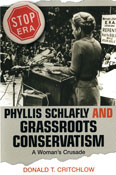
The last 60 years of conservative political and ideological struggles come to life in this important biography of Phyllis Schlafly, one of the most influential American conservatives. Unlike previous writings on Schlafly's very full life, this book concentrates on placing Schlafly within the context of larger historical currents involving the Republican Party, the Cold War, women's moral activism, and the entry of Christians into politics. Professional historian Donald T. Critchlow eschews the heated rhetoric that has swirled around Schlafly for most of her 81 years, preferring a detached, respectful tone as he depicts the progress of the post-World War II Republican Right. While Schlafly is best known for her post-1972 opposition to feminism, she devoted several decades of her career to anticommunist, pro-national defense causes. Professor Critchlow shines light on the anticommunist movement in the 1950s at the grassroots level, with seminars, study groups, radio addresses and book clubs that initially focused on the internal threat of communist agents in the U.S. and then evolved into a movement more concerned about the external threat of the huge Soviet arms buildup in the 1960s. The Goldwater presidential campaign of 1964 and the hotly contested 1967 purge of Schlafly from the leadership of the National Federation of Republican Women sharpened the differences between conservative and liberal Republicans, leading to the formation of well-defined conservative organizations whose influence has continued to grow up to the present. One tidbit unearthed in the archives - a letter detailing the lavish personal hospitality shown by then-Texas Congressman George H.W. Bush in his Washington-area home to anti-Schlafly Republican women delegates - illustrates the unique kinds of information assembled by the author. Schlafly's subsequent successful fight against the proposed Equal Rights Amendment to the U.S. Constitution involved an unprecedented coalition of evangelical Christians, Mormons, Catholics and Orthodox Jews, many of whom continue to work together on other family-values issues such as abortion, parents' rights in education, and same-sex marriage. Professor Critchlow's book, though not a fast read, performs a valuable service in debunking some of the myths about Schlafly and establishing a reliable historical record of a remarkable life. In contrast to the unsubstantiated assertions of at least one reviewer who must not have read the book, Critchlow makes it plain that the Midwestern conservatism which produced Schlafly grew out of anticommunism, not racism or anti-Semitism. Feminist conspiracy theories to the effect that the Stop ERA movement was funded by the insurance industry are similarly put to rest through his analysis of financial records. While the book does not attempt to be an exhaustive personal biography, neither the author nor the reader can escape a sense of awe at the sheer energy and productivity of Schlafly's life. Her relentless output of books, speeches, newsletters, radio commentaries, college debates, television appearances, political campaigns, lobbying activities and organizational leadership, amid the demands of family life, venomous personal attacks, and the inexorable march of time, has earned the respect of even diehard opponents. (Princeton University Press, 2005, 304 pp. plus lengthy footnotes, $29.95) |
 Some five years of research in extensive archival sources - from the pre-internet era of voluminous written correspondence - give the book a wealth of vivid, previously unreported details from the trenches of political warfare.

