|
|
|
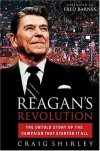
Political consultant Craig Shirley has written a fascinating account of Ronald Reagan's unsuccessful attempt to unseat Gerald Ford in the 1976 presidential race, in Reagan's Revolution: The Untold Story of the Campaign That Started It All. It is difficult now, at a time of Republican ascendancy, to remember just how low the Republican Party had sunk in wake of Watergate in the mid-1970s. Shirley takes us through the arduous primary race, where Ford emerged with an early lead, winning in New Hampshire, Massachusetts and Florida. Reagan, thought by many to be down for the count, won a stunning upset in North Carolina and went on to win in Texas, Georgia, Alabama, Arizona and many other states. Ford came back in his home state of Michigan to achieve a tiny lead, which Reagan tried to counter by naming Richard Schweiker as his running mate. This stratagem, crafted by Reagan's pragmatic campaign manager John Sears, was designed to muddy the waters and perhaps move some delegates to Reagan's side. While the ploy kept Reagan alive into the convention, Ford eventually prevailed. Sears was criticized for the move by many who thought Schweiker was too liberal. The candidates came into the convention in a dead heat, but the Ford machine proved adept enough to finally eke out a win. Reagan's stirring final speech started the clock ticking on the next presidential race, as he upstaged Ford and galvanized a new generation of young political enthusiasts. Ford lost to Carter, but Reagan established himself in 1976 as a viable national candidate. Shirley believes that this was the best of all possible worlds; Reagan needed a few more years to hone his message, and the country had to endure the disastrous Carter experience to make it receptive to Reagan's new approaches in U.S.-Soviet relations and supply-side economic policies. Those with an interest in how politics really happens will enjoy this "sausage factory" tour of the process with its behind-the-scenes look at the candidates and their dedicated supporters. (Nelson Current Books, 354 pps, $25.95) |
 The Democrats dominated the congressional elections of 1974, and Republicans were reduced to wearing buttons that whined "Republicans are People, Too" and "Whip Inflation Now." Gerald Ford did not help matters by falling down in public places and explaining that, yes, he was smart enough to be president.

