|
|
|
Washington's Crossing presents a detailed analysis of the military tactics and battles of the Revolutionary War from 1776 to 1777. The central event, Fischer believes, was George Washington's crossing of the Delaware with his army on Christmas night, and the subsequent attack on Hessian forces at Trenton. This battle proved to be the turning point of the war, raising the morale of the soldiers, their leaders, and the country at large. The author opens his book by examining the famous painting of Washington's crossing by Emmanuel Leuntze. Fischer then plunges into a description of each of the armies and of their leaders. The Americans, unlike the British and Hessian forces, tended to be undisciplined and difficult to control, but the system was more democratic, allowing talented soldiers to rise quickly to important positions. Furthermore, Washington relied much more on input from his subordinates, and the tenor of his command might be described as leading free men rather than using inferiors to do the job. The British had many advantages such as a much larger, more disciplined army and more experience with war. During the first part of the Revolutionary War, in fact, the Americans lost most of the battles due to lack of experience and discipline. The American officers, including Washington, made several unwise decisions which led to heavy losses. By late December 1776, the Continental Army was in desperate straits. On Christmas Eve Washington decided that his only recourse was to take the Hessians in a surprise attack. His original plan miscarried because of hellish weather conditions and the ineptitude of some of his officers. Washington nevertheless managed to get his exhausted army across the Delaware River. It seemed at that moment they would be too late to take the Hessians by surprise, but Washington decided to attack Trenton anyway. Miraculously, the snowfall that had made their march so difficult hid them from view. The Americans were almost on top of the Hessians before they were discovered. They proceeded to trap their enemies on both sides and win a decisive victory. The Continental Army won battle after battle during the ensuing winter campaign. Washington's Crossing ends on this hopeful note, concluding that the American forces in effect invented a new style of military leadership, including greater democracy within the ranks and more flexibility in their operations. The book is dense with facts but should appeal to aficionados of military history. (Oxford University Press, 2004, 549 pps, $35.00) |
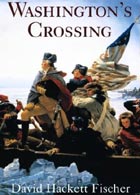 While some of its historical details are incorrect, it captures the scale of the event and the heroism of Washington and his soldiers.

