|
|
|
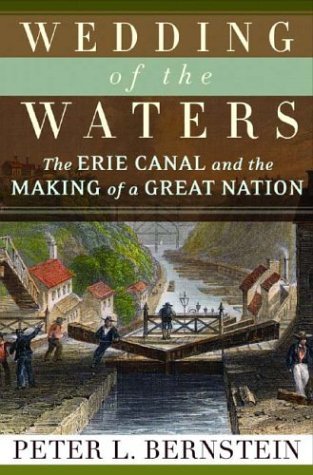
What was the most important public works engineering project ever undertaken by the United States government? Peter Bernstein makes a compelling case for the Erie Canal. The idea of joining the sea with interior waterways by linking the Hudson River to Lake Erie had been bandied about as far back as the late 1700s. It is difficult to overstate the importance of the canal in American economic history. Without a connecting artery of its magnitude, the young country might never have really coalesced because of an inability to develop internal trade and commerce. And the canal certainly vaulted New York City to the forefront of the American, and ultimately, the world economy. Bernstein, an economic consultant, details the astounding impact of the canal. Small villages like Syracuse and Rochester quickly became industrial powerhouses. Buffalo, located at the canal's western terminus, became the greatest inland port in the United States. The huge volume of grain traffic from the west made it the largest and most active grain transfer point in the world. Financially, the canal was an outstanding success, exceeding even the most optimistic predictions of its visionary backers. Its debt was fully retired only ten years after its opening in 1825. The actual construction of the canal was an awesome feat of engineering. The mostly Irish diggers had little more than picks, shovels and crude explosive devices to work with. The chief planners of the actual construction of the canal were surveyors, not trained engineers. Indeed, at the time, there simply were no trained engineers in America. But dogged Yankee ingenuity and the tireless support provided by New York governor Dewitt Clinton, Martin van Buren and Gouverneur Morris, gave the project the necessary momentum. A crucial decision was to use small crews of locals to dig a series of small canals that were all joined together. The untutored laborers were able to use their knowledge of local conditions to speed construction. The author produces an outstanding overview of the economic and social ramifications of the canal project, and also does an excellent job of portraying day-to-day life on and around the canal. A journey could be picturesque, with mules slowly pulling the long, narrow boats, and gaily dressed passengers enjoying the view. The animal odors and the rowdiness of the typical canal workers sometimes intruded on this blissful scene. A short review cannot do justice to this wonderful book. Read it and be amazed at the diversity and dynamism of the American economy. (WW Norton Co., 2005, 381 pps, $24.95) |
 George Washington, a surveyor, believed it possible and desirable. Thomas Jefferson, on the other hand, thought the notion was insane. One has to sympathize with Jefferson when pondering the difficulties of carving a 363-mile canal through the Appalachian mountains.

