|
|
|
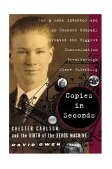
Perhaps no other invention so revolutionized office life as the copying machine. In Copies in Seconds: Chester Carlson and the Birth of the Xerox Machine, David Owen tells the remarkable story of the conception and development of this epoch-making device. Chester Carlson was the son of Swedish immigrants who spent his youth in almost unendurable poverty, living at times in abandoned chicken houses and shacks with his sick father. The shy, quiet boy managed to work his way through junior college and ultimately through the California Institute of Technology, where he trained as a physicist. After some years working in various engineering capacities, he put himself through law school and became a patent lawyer, never losing sight of a long-held dream: to make a machine that would copy an image onto plain paper. Carlson’s concept, of using photoelectric properties of materials and static electricity to bind fine particles to plain paper, was so idiosyncratic that many first-rate scientists question whether anyone else would have ever come up with the idea if Carlson hadn’t. But coming up with a brilliant concept was just the beginning of a very long journey. It took more than 20 years for Carlson’s invention to reach a large market. Many of the greatest names in American business, including IBM, RCA and Bell and Howell, turned down the opportunity to develop Carlson’s ingenious idea. It fell to a small company called American Haloid (to be known later as Xerox), operating on a shoestring, to bring the product to fruition. Carlson’s original idea was complex enough, but the actual machine that became the foundation of Xerox’s phenomenal success was an amazingly complicated device with innumerable finely tuned wheels, gears, pulleys and other parts. Once the machine's capabilities became known to the office workers of America in the early 1960s, the Xerox 914 became one of the best-selling products ever. Even the rosiest predictions for numbers of copies proved comically short of the actual numbers produced. Amazingly, in an era when technological change has made many new products obsolete, Carlson’s idea has yet to be superseded. Carlson made hundreds of millions of dollars from his revolutionary machine, but never lost the modest simplicity and quiet faith that made him such a popular figure with his co-workers and business partners. (Simon and Schuster 2004, 283 pages, $24) |
 Forced to scrounge for money from the time he was a little boy, he held a variety of odd jobs and became the family’s chief provider before he entered high school.

