|
|
|
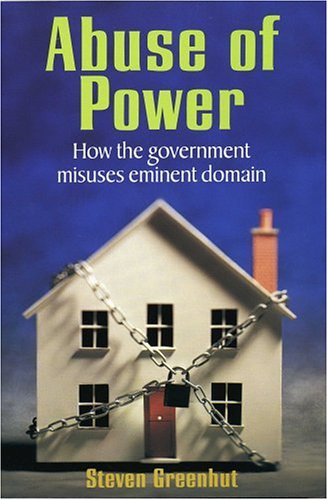
John Adams wrote, "The moment the idea is admitted into society that property is not as sacred as the law of God, and that there is not a force of law and public justice to protect it, anarchy and tyranny commence." Tyranny has arrived in the neighborhoods of America. As passionately reported and meticulously documented in Abuse of Power: How the Government Misuses Eminent Domain, by Steven Greenhut of the Orange County Register, cities' abuse of the power of eminent domain has reached a crisis point. It all began innocently enough. The Constitution provides that the government may take property for public use, as long as the owner is compensated for the loss. In a procedure that happens with frightening regularity all over the country, local governments have used "blight" and "economic development" as covers for mowing down thriving private businesses and homes in order to pave the way for well-heeled developers to build new big-box shopping centers and theme parks. Certainly the cities and the developers are happy. The cities might get the increased sales tax revenue that is always predicted, at least until one of the big-box stores becomes an abandoned eyesore, a victim of the next retailing trend. The developers get a big new shopping center at a bargain basement price. It's the former landowner or displaced business that comes up short. Cities hire aggressive lawyers whose job is to squeeze out often unsophisticated and frightened citizens. Ridiculously inadequate appraisals are produced. True costs of relocation are never reimbursed. Decades of goodwill can vanish, as neighborhood businesses are told simply to move, often many miles away. A court challenge is expensive, time-consuming and mentally draining. And the price of expensive lawyers defending the little guy isn't included in any settlement. Along with the injustice of people being kicked out of their homes and businesses, there is the additional downside of land development being driven by municipal bureaucrats instead of by private property owners. Corruption is a constant danger. Members of city boards are often easily swayed by financial incentives offered by developers. Along with the injustice of people being kicked out of their homes and businesses, there is the additional downside of land development being driven by municipal bureaucrats instead of by private property owners. Corruption is a constant danger. Members of city boards are often easily swayed by financial incentives offered by developers. Greenhut documents case after case of real people who have had their lives destroyed by this corrosive process. But he also points to some successes on the part of individuals and businesses who have banded together to mount legal and especially political campaigns to fight the invaders. Shortly after this book was published, the Michigan Supreme Court overruled its influential 1981 Poletown decision, which allowed General Motors to effectively condemn a large residential neighborhood for a new manufacturing plant. Economic development is no longer a sufficient basis for condemnation in Michigan, although "slum clearance" still is. The U.S. Supreme Court has agreed to review an economic development condemnation case in New London, CT. Perhaps the judicial branch is finally taking note of the abuses of the takings clause in federal and state constitutions. (Seven Locks Press, 2004, 276 pages, $17.95) |
 But what started as a reasonable means for the public to be served by legitimate conversion of private property to uses like highways or parks, has become a way for private developers to enrich themselves at the expense of homeowners and small businesses.

