|
|
|
In Where the Right Went Wrong Patrick Buchanan cogently argues that the Republican Party and its leader have been lured into a disastrous global war that subverts everything true conservatives stand for. Buchanan’s evidence will give even the most loyal Bush supporter pause. Long before 9/11, neo-conservatives like Paul Wolfowitz, Bill Kristol and Elliott Abrams were advocating the invasion of Iraq. They continued to advocate it in the days immediately after the Twin Towers were hit. The neocons didn’t just advocate the war they thought would be a cakewalk in Iraq. They had larger designs for the entire Middle East. Pundit Max Boot said that America is "an attractive empire – everybody wants to join." Charles Krauthammer exulted that "people are coming out of the closet on the word ‘empire’." Buchanan attacks the whole idea of a "war on terror" – which he believes to be unwinnable. He traces the history of terror tactics back to the time of Rome and Carthage, and while he thinks terrorists can be defeated by a patient, democratic government that has the support of the people, he believes that, in the autocratic Middle East, there are too many who hate us too much for us to prevail. Buchanan continues his indictment of Bush Republicanism in the area of international trade. He forcefully makes the Hamiltonian case for protection of markets at home in order to stimulate American industry and protect the wages of the working class. No free trader, he thinks open markets are a vehicle for robbing America of its industrial base and destroying the dollar. Some of the author’s strongest language is reserved for the imperial judiciary that has taken over vast sectors of ordinary people’s lives. He advocates congressional removal of court jurisdiction over matters properly left to the states. Despite his many disagreements with Bush Republicans, however, Buchanan makes it clear that he supports the reelection of President George Bush. He notes that Bush’s judicial appointments have been excellent, that the president followed through on his pledge to cut tax rates and that he has protected the homeland since 9/11. This combative book is must reading for anyone interested in world affairs. Whether or not you agree with him, there is no more colorful, concise writer than Patrick J. Buchanan. (St. Martin’s Press, 2004, 254 pages, $24.95) |
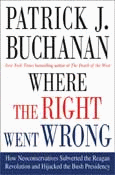 He believes that the neoconservatives, who he convincingly claims now control the Bush Administration’s foreign policy, are hypnotized by the image of America as a new Roman Empire – a single hyperpower that can direct and control events all over the globe. He also thinks the war in Iraq is a dangerous diversion from the primary job of hunting down Osama bin Laden and his agents.

