|
|
|
One of the most striking images from late 20th-century America was the demolition of the Pruitt Igoe housing project in St. Louis, MO. How could policies designed to help the poor lead to a situation so dire that the government finally had to give up and destroy the buildings? The answers to this and many other perplexing questions are found in a concise new book by Howard Husock: America's Trillion Dollar Housing Mistake. Husock destroys the myth that the free market cannot supply adequate housing for the poor. In fact, it did so for many decades, from the bungalows of Oakland to the four-flats of Chicago and the three-deckers of Boston. But social visionaries, convinced that they could do better, created the public-housing monstrosities that quickly became breeding grounds for crime and destruction. Pruitt Igoe, like so many other public housing projects constructed around the country in the 1960s, was based on the false premise that simply providing any poor person with adequate housing would turn him into a productive citizen. But moral improvement is not brought forth by bricks and mortar. Rather, the result has been more dependency, illegitimacy and crime. When it became obvious even to the experts that housing projects weren't working, they were ready with an equally disastrous Plan B: vouchers given to the poor to enable them to move into working-class neighborhoods. Needless to say, the hard-working residents of those neighborhoods did not welcome the crime and chaos brought by their new neighbors. The next brainstorm, the Community Reinvestment Act, has turned into a vehicle for left-wing pressure groups to force banks to loan money to people who would not pass muster under normal credit standards. Predictably, this policy has resulted in a disproportionate number of foreclosures and losses, as well as damage to the middle-class neighborhoods where the loans tend to be made. Community Development Corporations, another Big Idea, are nothing more than taxpayer-subsidized vehicles for creating more projects with all the same problems as the old ones. But there is hope in the private sector. Husock details the stunning track record of Habitat for Humanity, which has revolutionized delivery of quality housing to the poor. Its secrets? Tough approval standards and a requirement that the lucky family invest plenty of their own sweat equity in the project. Pride of ownership has once again proved its magic. Habitat is already the fourteenth largest homebuilder in America. Some cities, like Charlotte, NC, are taking a cue from welfare reform and requiring residents of public housing to limit their stays. The results have been encouraging, as beneficiaries realize that they have to work their way out of their dependent status. It is refreshing to see a book of such candor come out of Harvard University. Anyone interested in the future of American low-income housing will profit from this volume. (Ivan R. Dee, 2003, 131 pages, $19.95) |
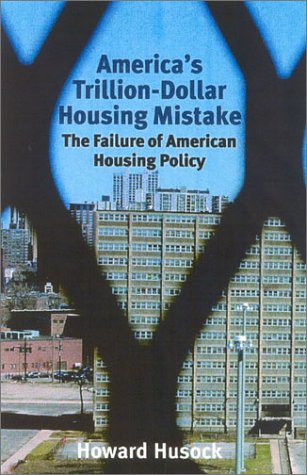 Husock is professor of government at Harvard University's John F. Kennedy School of Government, and his book is actually a collection of seven essays written over the past six years. This approach results in a certain amount of repetition, but the main points of the book are well worth repeating.

