|
|
|
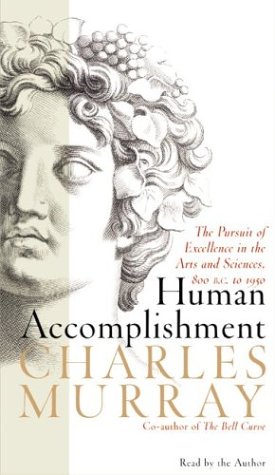
If you read one book this year, it should be this one. It is a unique overview of human history by a great social scientist who spent five years developing his thesis and supporting it with the statistical tools of his profession. The result is a paean to Western civilization, and specifically the dead white European males (DWEMs) who overwhelmingly contributed to the arts and sciences. Human Accomplishment uses persuasive statistical techniques to list the most significant figures, including a top-20 ranking in each field. The author constructed his data from the proportion of space accorded More interesting than the rankings, however, are the discussions of the conditions that gave rise to genius. Murray concludes that the "giants" overwhelmingly emerged between 1400 and 1900 from four countries in Europe, aided by such factors as prosperous cities with good schools and universities and some political freedom. He insightfully analyzes the resilience of accomplishment amid adverse conditions such as warfare and plague; the dearth of female significant figures; the flowering of Jewish achievement after anti-Semitic restrictions were lifted; and the more recent rise of U.S. accomplishment. But why did Western Europe predominate and not Asia, Russia or the Arab world, all of which made valuable contributions? Murray's answer turns out to hinge on Christianity. The ancient "Greek miracle" hatched Western individualism, but it took the Christian doctrine of the equality of all people in the eyes of God, plus Thomas Aquinas's exaltation of reason as pleasing to God, plus the Reformation's assertion of the individual's direct relationship with God and Scripture, to foster the sense of purpose and autonomy that best enable genius to flourish. Brilliant people in the East had to contend with cultures showing far more deference to clan, tradition and authority, and aversion to debate and innovation, than obtained in the West. The author, whose best-known books are Losing Ground and The Bell Curve, concludes that even as political and economic freedom have rapidly improved the human condition, the rate of accomplishment in the arts and sciences has been declining at least since the 19th century. Europe's run may have ended. The sciences remain committed to their essential ideal of truth and may be expected to continue to advance the cause of civilization. The arts, however, have lost their connection to the transcendental triptych of the true, the beautiful and the good. Notwithstanding the rigorous social-science methodology, Human Accomplishment is no dry recitation of facts and figures. This is a book of broad learning and conviction. It is an inspirational tribute to the most creative people in history and, indirectly, a rebuke to the recent academic fashion of devaluing DWEMs. It will give any reader food for thought. And it will stimulate reflection about the biggest question of all: What did Michelangelo, Shakespeare and Beethoven know about the meaning of life that the creative elite of the 21st century have yet to discover? (HarperCollins, 2003, 458 pps exclusive of lengthy appendices, $29.95) |
 to the figures in encyclopedias and biographical dictionaries concerning the sciences and technology, and Western and non-Western philosophy, music, literature and visual art. Graphs and lists are interspersed with historical summations, analyses, anecdotes and cogent arguments to give the reader the big picture of progress and the phenomenon of genius.

