|
|
|
Not so long ago, the New York Times was considered a well-written and balanced newspaper of record. But the sterling reputation of the Grey Lady recently received a tarnishing at the hands of Jayson Blair, whose fabricated stories set a new standard for journalistic dishonesty. Damaging as the Blair revelations were, the problems at the Times go far deeper than one lazy, dishonest reporter, and beyond even the quest for newsroom diversity that helped mold him. A perfect example was the controversy over Tiger Woods playing at Augusta National Golf Club, which does not admit women. The Times carried an editorial urging him not to play. When Tiger refused to be cowed, the newspaper tried to intimidate CBS, which held the broadcast rights, with a news story (not an editorial) headlined "CBS Stays Silent on Debate on Women Joining Augusta." Is it "news" when an entity does not follow the Times' party line? In one damning chapter after another, Kohn details the countless ways in which the Times intentionally employs specific techniques to twist facts and coverage to promote its liberal agenda. Start with the headline. Many readers never get past it, so its content and tone are important. A slanted headline can influence the way readers react. The Times routinely uses headlines to downplay a story's importance or subtly contradict its content. Or look carefully at the lead. A typical story concerns Vice President Dick Cheney's sale of Halliburton stock. The lead stated that his "tenure is under scrutiny from government investigators and his political opponents." But no investigators or opponents were cited in the article. Then the story noted portentously that Cheney sold the stock at $50 per share and it later fell to $13.20. Not mentioned was the fact that Cheney sold only after he was nominated for vice president - and was hounded by the media to sell. The influence of the Times goes far beyond its readership. All three major network news anchors quote the Times reflexively to their 15 million viewers. One can only hope that the message of Kohn's book can reach this immense audience, so that some sense of balance and fairness can be brought back to the news. This hard-hitting exposé will forever change the way its readers react to the newspaper. Just don't expect to read about it in the Times! (WorldNetDaily Books, 2003, 321 pps, $25.99) |
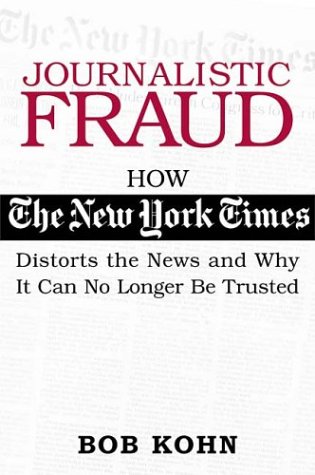 As Bob Kohn shows in Fraud: How the New York Times Distorts the News and Why It Can No Longer be Trusted, the Times'increasingly liberal worldview has metastasized from the editorial page to the front page.

