|
|
|
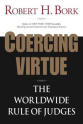
One only has to pick up the newspaper to observe how all-powerful judges have become in this country. In a concise new book, Coercing Virtue: The Worldwide Rule of Judges, Robert Bork explains how and why this has happened, and why it is a very alarming thing. The title is really a bit tongue-in cheek, because the "virtue" that Bork talks about is actually nothing more than the value system of what he calls the "new class." He identifies this class with academics, intellectuals, heads of foundations and purveyors of notions of social justice. In short, liberals. In recent years, liberals have come to command the heights in the great culture struggles - the museums, the foundations, the media and the universities. Bork traces the legal history of this problem to Marbury v. Madison, in which Justice Marshall's broad concept of judicial review laid the groundwork for ultimate rule by unelected judges. He continues up through Dred Scott, Brown v. Board of Education and Brandenburg v. Ohio, showing how the Supreme Court moved beyond simple procedural due process to a notion of "substantive due process" that has become a vehicle for imposing the will of judges on Americans without the messy process of passing legislation. The results are all around us. The courts show a fanatical devotion to free speech, as long as it is pornographic enough. On the other hand, political speech (the core value of the First Amendment) is being eroded through court-sanctioned campaign finance restrictions. Meanwhile, the judiciary's chief interest in religion seems to be in keeping it out of public display. An obsession with created-by-fiat privacy rights has led to abortion on demand and now possibly gay marriage. The problem of overreaching judges is not confined to our country; it appears in European nations as well. Unfortunately, these imperial tribunals are not only a threat to their own countries. As the European Union grows in power, courts in The Hague and elsewhere are busily asserting their power over the internal affairs of the United States, and many liberals would be only too happy to comply. An additional problem is the increasing tendency of certain Supreme Court justices, like Stephen Breyer and Ruth Bader Ginsberg, to rely on other countries for "help" in interpreting our own laws. Thus in a recent Supreme Court decision, Justice Breyer looked to Zimbabwe for help in interpreting an American statute. It is doubtful that most Americans would consider this a salutary development. Bork also gives detailed analyses of the judicial situations in Israel and Canada, where rule by judicial fiat is even more insidiously evolved than in the United States. The book ends with a clarion call to citizens to wake up and understand how their country is being transformed by people wholly unequipped by temperament or training to become the arbiters of American culture. (AEI Press, 2003, 139 pages, $25) |
 Driven by their religion-substitute, a socialist vision of utopia on earth, they have successfully co-opted the courts as their allies in a concerted effort to push the country far to the left of where mainstream Americans would like it to be.

