|
Laws intended to eradicate discrimination are being passed and enforced in blatant disregard of core constitutional rights to free speech, association and exercise of religion.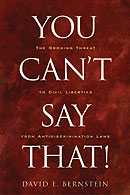 George Mason University law professor David E. Bernstein amply proves this thesis in You Can't Say That!, which catalogs the numerous threats to liberty posed by federal, state and local laws against discrimination on the basis of sex, race, disability, age, height, weight, marital status, and even body piercing and motorcycle gang membership. George Mason University law professor David E. Bernstein amply proves this thesis in You Can't Say That!, which catalogs the numerous threats to liberty posed by federal, state and local laws against discrimination on the basis of sex, race, disability, age, height, weight, marital status, and even body piercing and motorcycle gang membership.
The parade of horrors assembled by the author includes:
- A 240-pound woman forced an aerobic exercise company to drop its requirement that instructors have a fit appearance, based on San Francisco's weight discrimination law
- During the Clinton Administration, HUD harassed and ordered the prosecution of community activists who opposed the construction of housing for the homeless in their neighborhood, based on the Fair Housing Act
- Human models have virtually disappeared from real estate ads because of HUD rules requiring advertising to be "inclusive" (i.e., containing a quota of non-white models), and newspapers have banned certain phrases deemed offensive under fair housing laws including "walking distance from synagogue" (insensitive to non-Jews), "great view" (insensitive to the blind), and "walk-up" (insensitive to the wheelchair-bound)
- The EEOC has sued small employers of immigrant groups for relying on word of mouth to recruit employees, charging that the lack of general advertising constitutes race discrimination
- The California supreme court required the charity Boys' Club to go coed, under a state law banning sex discrimination in "business establishments," prompting the philanthropist who had endowed it to withdraw her funding
- Several state courts have upheld prosecutions of religious landlords for refusing to rent to unmarried couples, based on laws banning discrimination on the basis of marital status
- While people seeking roommates generally may discriminate, advertisers are restricted from mentioning any discriminatory preferences in ads, making it much harder for people who want "no Republicans" to find like-minded co-renters
- Women-only health clubs have been forced to go coed in several states, and the EEOC has sued some for refusing to hire male employees
- Campus speech codes have chilled speech at public and private universities and led to severe sanctions for trivial utterances, flyers and T-shirts, while college newspapers deemed offensive have been stolen or destroyed with impunity
The examples amuse and astound the reader, but the author does more than compile a long list. He stitches the cases together with insightful legal analysis and a forceful argument in favor of reinvigorating the First Amendment as a defense to the ever-proliferating antidiscrimination laws. Not all his arguments will appeal to conservatives, but, consistent with the values of the publisher, the libertarian Cato Institute, he steadfastly takes the side of the Bill of Rights as against governmental interference.
The ACLU comes in for some criticism for abandoning its historical mission of protecting civil liberties in favor of its goal of social equality. "Punishing speech because it creates offense has absurd and totalitarian implications," Bernstein reminds us.
(Cato Institute, 2003, 166 pps., $20)
|

