|
|
|
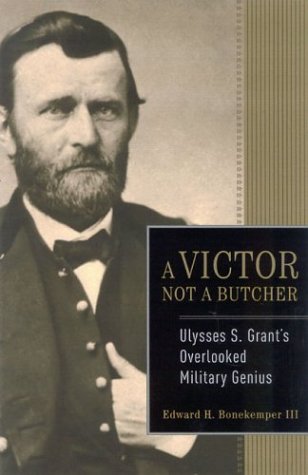
Ulysses S. Grant is usually characterized as a plodding general of little native talent who simply threw superior numbers of soldiers at the enemy until he overwhelmed it. Robert E. Lee, in contrast, is depicted as an adroit, careful tactician who made the most of his outnumbered troops. In A Victor, Not a Butcher: Ulysses S. Grant's Overlooked Military Genius, Edward H. Burkemper III makes a convincing case that the opposite is true. Burkemper presents carefully researched data showing that Grant was a tremendously skillful fighter who achieved tactically brilliant victories at Shiloh, Vicksburg, Appomattox and many other places while usually losing either fewer soldiers or a smaller percentage than his opponent. This is all the more remarkable because Grant was usually the attacker. Grant is a fascinating figure because of the contrast between his awe-inspiring success as a fighting general, and his utter failure at everything he tried in the years leading up to the Civil War. Bedeviled by a drinking problem (which never caused difficulty in wartime) and lurching from job to job, he was the last person one would expect to become one of the greatest generals in American history. Grant had talents that were tailor-made for military leadership. He was an outstanding horseman. He possessed an amazing ability to memorize maps at a glance and integrate their information into the actual topography of the battlefield. He showed a chessmaster's skill at troop deployment. Grant seemed to plan in three dimensions while his opponents managed only two. Grant's written orders were models of clarity; he was well known for concisely spelling out his ideas even in the most intense moments of battle. This deceptively simple style is evident in his memoirs, which are considered classics of their genre. Grant was also an efficient executive, trusting his shrewdly chosen lieutenants to carry out his orders with a minimum of interference. He was decisive and resolute, a supreme military realist who never let emotion get in the way of cold calculation. Beyond his abilities as a tactician lay Grant's strategic understanding of the need for a total war of complete economic destruction against the South. While Lee decimated his armies in a misguided attempt to win an offensive war, Grant ruthlessly carried the war into the heart of the enemy's homeland. All these qualities made U.S. Grant the most formidable general of the Civil War. It is no accident that he accepted the surrender of three Confederate armies and was involved in literally every major Union victory. It is difficult to see how the North could have won the war without Grant. Here was truly a man who changed the course of history. As Abraham Lincoln pithily remarked, "I can't spare this man - he fights." (Regnery, 2004, 270 pages, $27.95) |
 Lee certainly cut a more romantic figure than the stumpy, carelessly dressed, cigar-chomping Grant, but he was not his equal as a commander.

