|
|
|
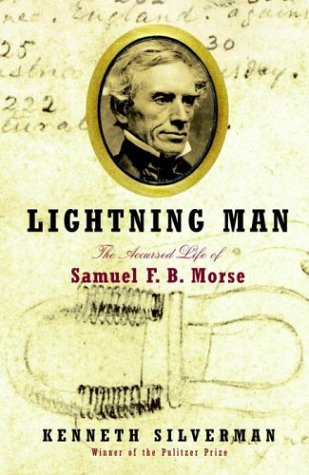
"What hath God wrought!" Thus did the deeply religious Samuel Morse marvel at his invention and deployment of the telegraph, one of the true wonders of the 19th century. In his compellingly written Lightning Man: The Accursed Life of Samuel F.B. Morse, Kenneth Silverman recounts the improbable story of the talented but frustrated artist and painter (of more than 300 portraits and larger historical canvases) whose name became synonymous with technological innovation. Perhaps no other single invention besides the railroad did so much to bind the young America into an integrated whole. And no other transformed so many areas of daily American life: journalism, commerce, finance, military and governmental affairs. Morse was entirely self-taught; his abilities as an inventor and engineer appear to have sprung fully formed from his mind. Before Morse, all competing systems had merely been semaphores like naval flags, i.e., they only communicated information but did not record it. It is hard to read this book without seeing the parallels between the telegraph and its modern counterpart, the internet. Both were greeted with open-mouthed wonder and adulation, and both spawned innumerable improbable predictions. Enthusiastic newspapermen predicted that the humming strands would encourage familial bliss, civic order and the elimination of crime. People gaped in awe at the transformation of human thought into electrical impulses flashing through a wire. Like the internet, of course, the telegraph radically changed the face of the earth. The sprawling young nation was suddenly endowed with a nervous system that laid to rest the fear that it was just too large to be governed effectively. Time and distance suddenly evaporated. Morse was personally involved in the laying of cable across the Atlantic, which was in itself an engineering marvel. Once the telegraph was up and operating, the federal government became interested in managing it. Having watched with dismay the snail-like Congressional response to his original requests for government grants, Morse was highly dubious of the wisdom of governmental control. His view prevailed, and Western Union (of which Morse became a large stockholder) became synonymous with speedy, reliable communication provided by private enterprise. Despite his technological prowess, Morse's life was indeed "accursed" in many ways. The process of securing patents and actually overseeing the erection of the system was a daunting task which made him a long-distance father to his children. Morse was no businessman, and his myriad battles with lawyers and sharp-minded business foes left him bitter and exhausted. In the end he received his due, and he has gone down in history as the embodiment of home-grown American engineering genius. (Alfred A. Knopf, 2003, 445 pages, $35) |
 Morse's breakthrough was to come up with a reliable way for a machine to record information ? to write at a distance. Additionally, of course, he came up with the ingenious code that bears his name.

