|
|
|
The Great War is rightly seen as the dividing line separating the modern world from the old. Americans take pride in the story of the doughty doughboys who filled the trenches in 1917 to throw back the rapacious Huns threatening to devour Western Europe. But the story of America’s role in the First World War is a complex one, and Thomas Fleming’s Woodrow Wilson ran his 1916 campaign on the theme "he kept us out of war." By 1917, spurred by British propaganda, he called for a "war without hate" to make the world "safe for democracy." Revving up the war machine required plenty of hatred. Wilson’s minister of information, George Creel, whipped up the frenzy, and Wilson ruthlessly enforced the sedition laws. The Allies had convinced Wilson that no American troops would be necessary, but American boys were soon dying at the front. Only the iron will of John "Black Jack" Pershing kept the fanatical Allied field commanders from sending tens of thousands more Americans to be slaughtered by their failed "strategies" of human carnage. Even so, ultimately more than 50,000 Americans died in battle. Ironically, once the war was over, Wilson couldn't turn off the wartime hate-spigot. His propaganda machine had been so effective at demonizing the Hun that his postwar calls for moderation fell on deaf ears. The European powers crushed Germany with reparations and employed the sort of backroom power politics that Wilson abhorred. Wilson didn't help matters by spending a lot of his time touring Europe giving speeches praising the common man that sounded to the victors like Bolshevism. If ever a visionary’s ship splintered on the rocks of the real world, it was Wilson’s. Having failed to change the world with his Fourteen Points, Wilson proved equally inept at promoting his other obsession, the League of Nations. While he spent his time on this hopeless project, the domestic situation in America deteriorated as the country made the transition from war to peace. Wilson's inability to convince Congress to ratify U.S. membership in the League was one of the most poignant failures in the history of the American presidency. Even more heartrending were Wilson’s concessions to his allies in the Treaty of Versailles. In exchange for Allied support of the League, he allowed a vindictive peace treaty to be signed, which led directly to the rise of National Socialism and World War II. No reader will come away from Fleming’s meticulously researched book without a healthy skepticism for becoming embroiled in distant wars and foreign entanglements. (Basic Books, 2003, 490 pages, $30) |
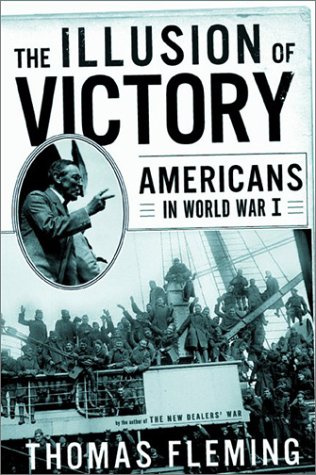 The Illusion of Peace: America in World War I is a storehouse of thought-provoking revisionism.

