|
|
|
The American Revolution was the fruit of the ideas of a legion of brilliant political philosophers. But revolutions are won by soldiers and sailors, not thinkers. And revolutionary America had few commanders to lead its fighting men. One of the most colorful and effective was John Paul Jones, "the father of the American Navy." This complicated man is the subject of a splendid new biography by Evan Thomas. The son of a gardener in Scotland, Jones came to America at an early age. Jones had to spend large amounts of time just trying to procure ships, while intrigue swirled around him. He was prickly and difficult. His usually patient superiors, Franklin and Adams, wearied of Jones' constant demands and (usually justified) complaints. Various romantic liaisons added to the complications of his life. When he did manage to acquire a ship, Jones put it very good use. In a famous raid early in the war, he landed in Scotland, burned British ships, and spread fear and consternation among the British. Public fear and outrage forced a diversion of substantial British sea forces, and Jones' exploits emboldened America's ally, France. In his most famous sea battle, he took on the British ship Serapis. Though outgunned by the faster ship with its highly trained crew, Jones miraculously won the day through guile and courage. Fearless in the white heat of battle, Jones seemed to become better humored and more daring as the danger grew. This was all the more extraordinary since Jones' crew was little more than a drunken, mutinous rabble. Author Thomas skillfully recreates epic battle scenes, and clearly explains many arcane sailing terms and tactics. The reader feels transported into the fury and chaos of the gun deck. Jones' last foray into naval warfare was as an admiral in the Russian Navy, fighting the Turks on the Black Sea. Though maligned and ill-used by Russian captains who resented him, and eventually abandoned by his patroness, Catherine the Great, he showed the same daring against the Ottomans that he displayed in the Revolutionary War. Jones' life was, in a sense, a microcosm of America's war for freedom - a struggle by a striver of humble origins to free and recreate himself in a new world where ability outranked noble birth. (Simon & Schuster 2003, 311 pps, $26.95) |
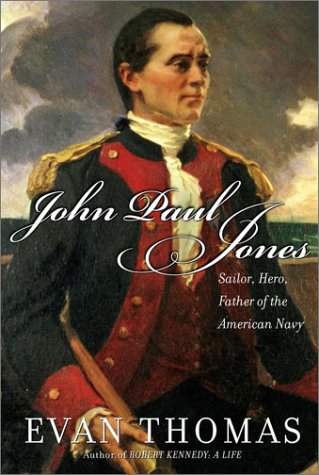 A natural seaman, he drew the attention of John Adams and Benjamin Franklin for his courage and daring. No other American combined Jones' tactical and strategic vision with a ferocious desire to "sail into harm's way," as Jones liked to put it.

