|
|
|
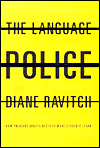
If you examine a typical grade school social studies textbook, you will probably notice a bland but preachy tone. Diane Ravitch’s book explains why this is so. In The Language Police, Ravitch shows how a shadowy bureaucracy exerts a bowdlerizing in-fluence on any text that can be accepted for wide use in U.S. public schools. The result is boring, in-sipid texts purged of anything that a hypersensitive liberal might consider offensive. Ravitch’s examples will make you laugh out loud. Here are some references that have been banned by various organizations or censors: "Eskimo" (inauthentic); the "aged" (ageist), the "mentally ill" (replace with "persons with emotional disability"); old folks (replace with "persons who are older"); "senior citizen" (demeaning); "profoundly deaf" (replace with "person with loss of hearing"). A 30-page appendix lists hundreds of such howlers. Ravitch explains why you can pick up any textbook and never see a male carpenter, a female nurse, a white male mathematician, an African-American janitor, or an Hispanic yardman. The effort to retell history to please liberal interest groups has the effect of distorting it. Suddenly the Revolutionary War seems less about George Washington than about women’s rights. The Mayans and the Iroquois loom larger than the English as a source of ideas for the Constitution. Slavery becomes the defining principle of the United States. The world’s religions and cultures seem interchangeable, so that fundamentalist Islam looks rather like a desert version of Presbyterianism. Primitive African countries appear deeply con-cerned about women’s issues and air pollution. In Ravitch’s view, a big culprit is the textbook procurement process. For any text to sell, it must pass muster in California and Texas. Textbooks become a group effort to pacify everyone and they quickly turn into liberal groupthink. Classic literature is edited and simplified so as not to offend anyone about what someone at some time somewhere might have thought, said or done. Three-syllable words are out. The result: simplified Shakespeare and no "Little Engine that Could" (no male trains allowed). Ravitch pines for smarter educators who respect students’ intelligence enough to trust them with uncut texts. She hopes to shine some light on the secret processes and let good sense prevail. (Alfred A. Knopf 2003, 255 pages, $24) |
 Such images drawn from the real world conflict with the PC fantasyland constructed by the textbook censors.

