|
|
|
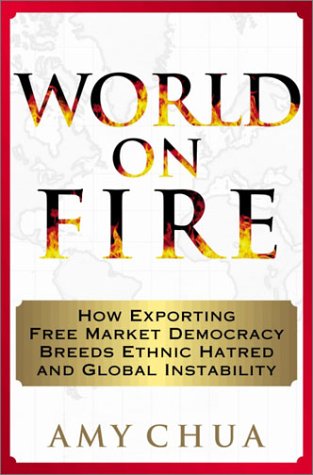
It is rare that a book is simultaneously praised by a radical Harvard Law School professor like Randall Kennedy and a conservative icon like Thomas Sowell. Amy Chua, a professor of law at Yale, has written such a book. In World on Fire, Chua lays out a compelling case for the view that the exportation of free markets and democracy, when combined with the seething ethnic tensions that exist in large portions of the Third World, leads to global instability and local chaos. Chua speaks from personal experience. Her aunt, a wealthy Chinese business magnate in the Philippines, was stabbed to death by her chauffeur, a poor Filipino. As Chua documents, such ethnic conflicts are the rule in virtually every Third World country. In western Africa, the Lebanese hold sway. In Eastern Africa, the Indians control the economies. In Argentina, descendants of German immigrants are in command. In Russia, seven so-called oligarchs virtually took over the country at the end of Yeltsin's rule. It's the same in South Africa, Chile and Mexico. In all cases the forces of free markets have led to the accumulation of great wealth in the hands of an ethnic minority, usually less than one percent of the local population. For the past 50 years, the United States has championed the expansion of free trade and democracy. This expansion created a perfect breeding ground for disenfranchised majorities in poor countries, egged on by demagogues, to take back what they are told was stolen from them. The political rhetoric was eerily similar all around the globe. The dominant minority is demonized in Hitlerian terms, the existing economic infrastructure is destroyed in an orgy of retribution, and the country is left in far worse shape than before. Zimbabwe is a perfect example. Originally colonized by the British, this rich country was democratized under the radical Robert Mugabe. After years of disastrous mismanagement, he decided that a convenient solution would be to redistribute the extremely productive white-owned farms to "the people." White farmers were forcibly evicted and murdered, and the country is now starving itself to death. Chua clearly shows how arrogant, cruel behavior by dominant elites is one of the causes of this unhappy state of affairs. She is less successful in explaining why so many countries seem destined for control by outsider elites. Are some cultures simply superior to others in the aggregation and control of material wealth? The book gives no easy answers to these hard questions. Chua hopes for better behavior from the elites, and for democracy and free markets to triumph in the long run. But in the short run, Western ideals in non-Western countries confront a harsh reality. (Doubleday 2002, $26, 256 pages) |
 The chauffeur is typical of the type that appears throughout the book: a member of a disenfranchised ethnic majority who feels that greedy outsiders have expropriated what should belong to "the people." The police identified the murderer's motive as "revenge."

