|
|
|
The telegraph played an essential role in the knitting together of the United States in the early 1800s. At the water's edge, however, it came to a dead end. How to traverse the great ocean with a wire, and link the Old World with the New? The time was ripe for the undertaking. Some cables had already been laid, but the longest underwater cable was just 110 miles long and lay at a depth of only 300 fathoms. The Atlantic cable would have to be more than 2000 miles long and lie as deep as 2,600 fathoms. This great project became the obsession of a young American entrepreneur, Cyrus Field. The well-educated son of a prominent preacher, Field amassed a considerable fortune in the paper business in the mid-1800s. His vision of instantaneous communications across the Atlantic was coupled with a winning personality and almost superhuman determination. These traits served him well over the thirteen years that it took to comlete the task. Field had no particular technical qualifications, but he had the necessary seed money, and through his energy and enthusiasm was able to raise additional funds from wealthy businessmen and governments. This ability to tap new sources of funds was crucial because heartbreaking, expensive failures followed one after another. The physical laying of the cable was an engineering project the likes of which had never been seen. The team employed some of the finest technical minds in the world, including William Thompson (Lord Kelvin) and Isambard Kingdom Brunel, regarded as the greatest engineer of the nineteenth century. Brunel was the railroad designer who constructed the ingenious rail line from Paddington Station in London to the city of Bristol, and who designed the Great Eastern, still considered the most remarkable ship ever built. This great vessel performed the Herculean task of actually carrying and laying the cable. By far the largest ship built up to that time, the Great Eastern was a feat of engineering genius. Powered by both steam and sail, it alone of all ships had the capacity and power to carry the nearly 3,000 miles of heavy cable needed for the job. Its cable-laying machinery, designed by an amateur, was so cleverly engineered that it is still in use today. The great ship went on to lay five more cables. Whole areas of engineering were revolutionized by the demands of the effort. New methods of shielding cable, measuring current flow, and tracking down dead spots in the cable had to be devised. Even with the advent of radio, the majority of communication continued to be carried by underseas cable, which was not subject to storms and changes in magnetic fields. Field put his entire fortune into this project over the course of six attempts to lay the cable. He eventually became a wealthy man again by virtue of royalties from the traffic flowing through the cable. He died a world-famous and beloved figure. In the era of the Internet, we take worldwide communication for granted. Cyrus Field, in following his magnificent dream, took the first step toward making global communication possible. (Walker & Co., 272 pps., 2002, $26) |
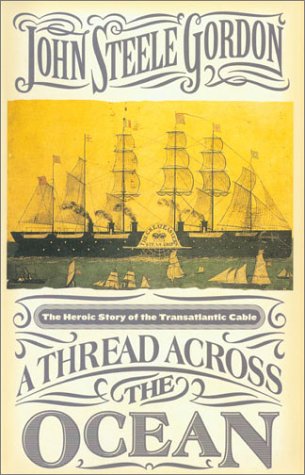 Aptly characterized by Arthur C. Clarke as "the Apollo Project of the Victorian Age," the laying of the cable is a fascinating story of salesmanship, perseverance and technological genius.

