|
|
|
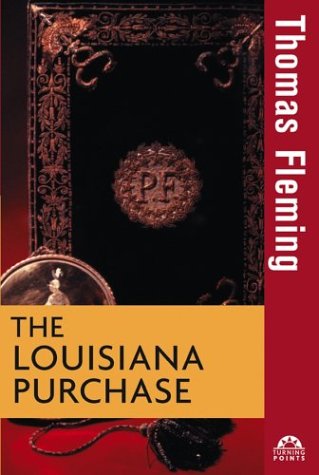
The Louisiana Purchase in 1803 marked a crucial turning point in American history. It doubled the size of the United States and led inexorably to further expansion to the Pacific Ocean. The shrinking pool of Americans who actually read about President Thomas Jefferson's remarkable coup probably recall that the United States received a very big chunk of land in the middle of the continent for a pretty low price. The conqueror of Europe was determined to rebuild French holdings in North America that had been lost in the Seven Years War. He got his opening when Jefferson invited the French to put down a slave revolt in Santo Domingo in 1801. Jefferson apparently did not sense the danger this involved, but Napoleon and his henchman Talleyrand certainly did see the possibilities. Fortunately for Jefferson, Secretary of State James Madison immediately saw the danger from a large French army next door. He was also disturbed by persistent rumors that an enfeebled Spain was soon to be induced to cede New Orleans to the French, thus threatening the shipment of American goods through that critical port. Robert Livingston, and later James Monroe were dispatched to France to attempt to gain American control of New Orleans. Negotiations were devious and complex, with Talleyrand and Napoleon's brothers attempting to siphon off their own piece of the deal. English ministers attempted to bribe them to oppose the sale, hoping to keep Napoleon focused on North America instead of on England. Meanwhile, the Americans thought they might need Britain as an ally in the event of war with France! Napoleon hemmed and hawed, but his hatred of England finally won out over his North American ambitions. Despite the objections of his brothers, he determined to sell the entire territory to the Americans. He wanted the money to prepare for an invasion of England, and believed he might still be able to foment enough trouble west of the Mississippi to somehow regain it later. Ratification of the treaty proved difficult. Northerners, particularly the Federalists, feared an expansion of Southern and Virginian power, and Jefferson himself had serious qualms about the constitutionality of the treaty if not accompanied by an amendment to the Constitution. In the end, pragmatism won out and the great purchase was consummated. In a single stroke, the United States was placed on a course that would lead to global supremacy. John Wiley and Sons, 2003, 192 pages, $19.95 |
 They probably don't remember that the whole affair was a dangerous chess game between an emerging power and the greatest military mind on earth, Napoleon Bonaparte.

