|
|
|
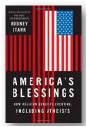
"Are religious Americans really a bunch of anti-intellectual philistines?" Rodney Stark, a Distinguished Professor of the Social Sciences at Baylor University, asks that question in America's Blessings. He then shatters the unflattering characterizations often associated with religious people. Stark analyzes statistical data and proves that believers are well-educated, well-balanced individuals who contribute greatly to the well-being of American society.
Another myth dispelled in America's Blessings is that we are becoming an irreligious nation. Although "mainline" religions have declined, conservative and non-denominational churches are growing and thriving. Seven in ten Americans belong to some religious congregation, almost half of Americans are in churches or synagogues on the Sabbath, 49% of Americans pray at least once a day, and while 31% claim to be very religious, an additional 42% claim to be somewhat religious. In 1990, 64% of Americans belonged to a church congregation, while by 2007 that number had grown to 70%. In contrast, the percent of American atheists has not changed in sixty years. It was 4% in 1944, according to a Gallup poll, and was still 4% in 2007, according to a Baylor University survey. Divorce rates are purported to be higher in the U.S. than in Europe, but statistics fail to take into account that in order to be considered "divorced," a couple has to first be in a marriage, an institution that is becoming all but obsolete in Europe. Stark supplies proof of a 7.6% longer and healthier life lived by religious Americans, of homeschoolers' academic successes, and shatters myths promoted by the media that paint religious people as uncultured and gullible. (Templeton Press, 2012, 197 pp., $24.95) |
 Stark illustrates contributions from religious citizens that benefit American society, including: success and good behavior which results in a lack of criminality, stable families that produce better behaved children, and generosity to secular and religious charities.

