|
|
|
Utility companies are installing Smart Meters in American homes with the ostensible goal of upgrading utility systems. But reality is more nefarious, according to Just Say No To Big Brother's Smart Meters. There are health and privacy reasons to refuse and protest the new technology. At best Smart Meters are dangerous and costly to citizens; at worst there are more sinister reasons for the plan to create a worldwide smart grid. Smart meters are digital and wireless meters used to remotely read and control energy usage. Energy use tells the story of a family: when they are at home, when they are sleeping, and when they use certain appliances and computers. Koehle says "this is not electrical metering. This is personal surveillance." The real-time wireless data obtained can be seen by the utility company, anyone to whom they sell the information, and any cooperating government agency. Since it is wireless, hackers and criminals can also quite easily tap into the information. Health dangers include electromagnetic field issues, similar to those posed by cell phones and computers. The Pacific Northwest National Laboratory, owned by the U.S. Department of Energy, has been developing "grid friendly appliances" that can be monitored and controlled from outside the home. GFA appliances will be the norm in the future. In addition to the control of family appliances, Smart Meters could lead to the rationing of vital utilities to businesses, destroying their autonomy and denying their capacity to produce, and putting them under the control of a utility company or even the government. Koehle says Smart Meters are tied to United Nations Agenda 21, a "sustainability" plan introduced at the 1992 Earth Summit, the stated goal of which is to "exercise control over 'every area in which humans impact on the environment.'" The ultimate goal of Agenda 21 is the degradation of America's prosperous way of life by balancing it out with the developing world. Smart Meters are a advocated by globalists who say there is not an energy problem but an "energy distribution problem." That is code for Americans use too much energy and they must be stopped. (Small Helm Press Associates, 2012, 291 pp., $19.99) |
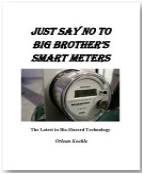 They replace the familiar analog meter, which has a spinning wheel and is checked monthly by a meter reader. The new technology provides "continuous two-way communication between the utility company and the consumer's property."

