|
|
|
Alfred Loomis is probably the most amazing American that most Americans have never heard of. Born of upper-middle-class parents, Loomis was a brilliant math major and inventor at Yale University. After attending Harvard Law School, he joined a prominent Wall Street law firm and in short order became one of its brightest young stars, specializing in complicated corporate financial transactions.
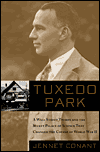
Always interested in science and invention, in 1926 Loomis bought a rambling old mansion in the exclusive Tuxedo Park neighborhood just north of New York City. He turned it into a private research lab, where he could work shoulder to shoulder with some of the world's most brilliant scientists and researchers. Over time, his private laboratory became a "must visit" for scientific and industrial leaders. As World War II engulfed Europe, Loomis and his researchers became focused on radar. When the British, desperate to perfect their own system, revealed their advances to the Americans, Loomis was able to incorporate their ideas and improve on them. Personally retiring but completely commanding by virtue of his razor-sharp mind, he was as critical as any other single man to this great project. Deftly moving from inventor to industrial titan, Loomis supervised the complex process of mass producing the new devices. He would soon play this leadership role again, helping to smooth the way for the development of the atomic bomb. Loomis was perhaps the greatest amateur scientist ever to emerge in America, and he unselfishly put his genius to work for his country. A true believer in freedom and free enterprise, he shut down his lab after the war, knowing that the lack of a war climate would remove a key ingredient in its success. Tuxedo Park evokes a golden age of amateur science, an age that soon gave way to the large-scale "industrial science" that Loomis's own efforts did so much to foster. (Simon & Schuster, 2002, 297 pps., $26.) |
 After a stint in the Army during World War I, where he made ingenious contributions to ballistics, he entered investment banking and made a fortune with his brother-in-law by spearheading the complex financing of the nascent electric utility industry. Sensing the oncoming Depression, he cashed out of the market, protecting the assets that would support his extravagant and idiosyncratic lifestyle.

