|
|
|
America was largely the creation of a constellation of brilliant and forceful men. Did any star shine more brightly in that cluster than Benjamin Franklin? James Srodes believes not. In a wonderful new biography, he argues that while Washington won the battles, Franklin won the war. No one put a more personal stamp on the new nation than Franklin.
Early on, he established himself as a political writer of note, counting Adam Smith and David Hume among his friends. Hume dubbed him "America's first philosopher and great man of letters"- quite a tribute from one of the greatest thinkers and writers in the world. Franklin helped knit the colonies together with a postal system he designed. One of only six men to sign both the Declaration of Independence and the Constitution, he also played a key role in developing the original Articles of Confederation. He spent years in Europe as an agent representing the colonies, and though he long hoped for a resolution with England, he was among the first to grasp the inevitability and intensity of the coming conflagration with the mother country. Fully 23 of his 86 years were spent in Europe, and his diplomatic triumphs in Paris and London, which secured the indispensable alliance with France, rescued the Revolutionary War from likely defeat. Srodes' description of the wily Franklin outwitting and overcoming Europe's most brilliant diplomatic minds is fascinating. Not gifted with natural grace or good looks, Franklin nonetheless mesmerized the lords and ladies of the salons with his "noble savage" air complemented by a natural wit and intelligence. With Jay and Adams, Franklin negotiated the final treaty with England to end the war. What shines through most is the pure force and energy of the man. Seventy years old at the time of the Declaration, he nevertheless served on ten committees for the Second Continental Congress, helped create and train the army, organized the clandestine transfer of gunpowder from the West Indies, and dealt with secret French agents in Philadelphia. At age 84, years after the Constitution had been ratified, he was agitating for the elimination of slavery and penning sharp-edged, influential prose. He maintained his characteristic wit and good temper to the end, adhering to a stoical and broadminded philosophy that had served him, and the country, so well during his long years of service. (Regnery Publishing, 2002, 450 pps. $34.95) |
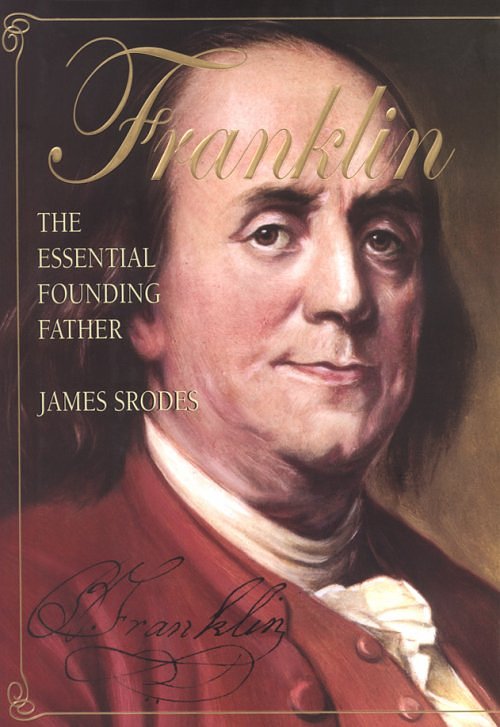 Franklin is justly revered for his many wonderful inventions and innovations: the lightening rod, bifocals, improved wood burning stoves, catheters for kidney stones, and scientific research that won him the 18th century equivalent of the Nobel Prize for improving our understanding of electricity. He was a pioneer in early American printing and a leader in the establishment of lending libraries. But his influence ranged far beyond these amazing achievements. Franklin deserves to be called chief architect of the United States of America.

