|
|
|
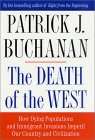
As a young teenager, Pat Buchanan was taught to box by his father. In his new book The Death of the West, Buchanan shows that he can still deliver a knockout blow. And judging from media reaction, he can still take a punch and keep on swinging. The book begins with a demographic analysis, which concludes that Europe, Russia, Japan and the United States are headed for decline because of the "birth dearth." The other side of the story is that Third World populations are exploding and the West is welcoming immigrants in record numbers. What sort of a new world are we constructing for our children?
Buchanan's search for the causes of the West's impending suicide turns up some unsurprising culprits: feminists who have devalued motherhood, radical gays whose mission is to destroy the traditional family, a consumerist, self-centered society, and a Hollywood culture obsessed with ripping down every standard of decency. But all these factors are dwarfed by the most fundamental loss, that of the religious underpinnings of Western civilization. Buchanan believes, with T.S. Eliot, that "if Christianity goes, then the whole of our culture goes" and must be rebuilt from scratch. While there are pockets of energetic, self-confident religious activity, such as the Mormons, in general the Catholic and Protestant faiths are losing vitality. The loss of vitality, history shows, is the precursor to population and national decline. Again, as Eliot says, "A people without religion will in the end find that it has nothing to live for." Is it likely that Pill-popping young women and their companions will decide any time soon to begin having more children in order to fix the demographic problem that we will face in 2050? Given our culture's focus on personal gratification, Buchanan seems dubious that his countrymen are ready to make the necessary sacrifices. How much easier it is to just outsource production of the necessary bodies to the Third World, and import. Buchanan offers thought-provoking ideas on stemming the immigration tide, but it is clear that he has serious doubts about America's will to resist the Mexican tide advancing from the south. He also puts forth practical measures for countering the cultural forces that encourage the balkanization of our country. First, however, Americans must realize that, in the face of relentless, fanatical enemies of Western faiths and traditions, cultural unity becomes a matter of life and death. Buchanan has a love of military metaphors, which sparkle throughout the book. He makes the reader feel as one of Buchanan's heroes, Robert E. Lee, must have felt when contemplating his beloved South's fate in early 1865: Time is short, our would-be conquerors many, and our confidence wanes. (Dunne Books, 2001, 320 pps., $25.95) |
 Not a pretty one, in Buchanan's view. Western civilization, beginning with the Greeks, and continuing through the Roman Empire, the Renaissance, the British Empire, and 20th century American hegemony, has given the world the best in science, technology, innovation, and political and moral systems. If the West is overwhelmed by newcomers who don't accept our institutions and values and refuse to be assimilated, the new order is unlikely to be as congenial to freedom as the old.

