|
|
|
The Conventional Wisdom of Americans about how we got into World War II probably runs something like this: A somewhat isolationist, peaceful nation was taken completely by surprise at Pearl Harbor on December 7, 1941. Americans rallied under a dynamic and unifying president who reached across party lines to lead the Allies to victory, ridding the world forever of the Nazi curse. There is certainly some truth in this description. But as Thomas Fleming, in a fascinating new book, The New Dealers' War, retells the history, there is much more to the story.
Franklin D. Roosevelt was determined to get the U.S. into the European war, but knew that the isolationist mood in the country was dead-set against him. Fleming produces voluminous evidence showing that Roosevelt decided that, if Germany learned of the scale U.S. preparations, Hitler would be provoked into declaring war. Hitler, however, had no wish to face an American war machine, and so the leak failed to accomplish FDR's objective. Fleming is persuasive in arguing that Roosevelt viewed a Japanese attack as another way of forcing the issue on America. While Fleming does not believe that FDR knew exactly where the attack would come, he presents strong evidence that FDR knew that "something" was coming, and soon. Pearl Harbor proved to be the back door that FDR wanted to get America into the European war with popular support. Yet, even after the attack, Americans remained deeply ambivalent about the war with Germany. Roosevelt deliberately followed a policy of squelching any intelligence of a German resistance movement. He insisted instead on the "unconditional surrender" strategy, which was opposed by virtually the entire military and which led to horrific casualties in Italy, Germany and Japan because it forced the Axis to fight to the death. Fleming masterfully covers the creation, decline and fall of the New Deal. In one particularly hilarious scene, we are treated to the spectacle of the "Petroleum Czar" Harold Ickes actually trying to steal rubber mats from the White House to meet his rubber quota! By the end of the war, of course, the "economic royalists" whom the New Dealers had railed against had produced a vibrant domestic economy with no need of Roosevelt's idea-of-the-week agencies. Indelible portraits of colorful figures such as Winston Churchill, Harry Truman and the flamboyant but flawed Wendell (One World) Willkie, sparkle across the pages of the book. Of particular interest is the in-depth coverage of Henry Wallace, the socialist true believer and presidential candidate who outdid even Roosevelt in his warm embrace of Stalinist Russia. Roosevelt's devious but pleasing personality won him many personal and political victories, but unfortunately, such a personality was easy for Stalin to manipulate. FDR's chief legacy is one of duplicity: he lied about sending our boys to war, he lied about internal resistance in Germany, and he lied to and deceived both political foes and allies. One has to admire FDR's courage at the end, as he put on a happy face for the voters and drove himself to physical exhaustion (and ultimately to his death) in the 1944 presidential race. But the question must be asked: was this not the final deception worked on the nation he purported to love? (Basic Books, 2001, 640 pps., $35) |
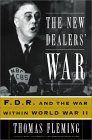 Fleming begins the book with a detailed analysis of the famous "Rainbow Five" leak of the top-secret U.S. plan to enter and win the war in Europe. He comes to the startling but convincing conclusion that the leaker was . . . the President of the United States.

