|
|
|
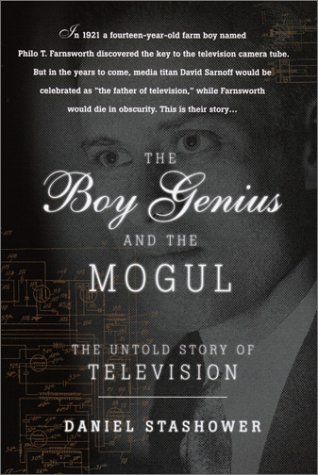
On a bright summer afternoon in 1921, a dreamy-eyed Utah farm boy followed a plow horse across the fields of his family's farm. As he watched the hay fall into row upon row of parallel lines, he was suddenly struck with a momentous idea that would change the world. The boy was 14-year-old Philo T. Farnsworth. The idea was television. Born to a Mormon farming couple, Farnsworth showed precocious ability as a natural engineer. At the age of three, he had his first glimpse of a train engine. After overcoming his fright at the size and sound of the iron monster, he asked to see "what made it go." That evening, he asked for a pencil and paper, and proceeded to draw an amazingly detailed picture of the engine. When still a young teenager, he confounded experienced engineers by solving knotty technical problems at the local hydroelectric plant.
A natural scientist and inventor whose formal education ended after two years of college, Farnsworth doggedly pursued his dream: electronic television with no moving parts. It is hard to imagine now, but the chief technological competitor at the time was a primitive mechanical system that used rotating mechanical drums to send an indistinct, flickering picture. Farnsworth was one of the very few who could see that this crude approach could never be the final answer. His ingenious idea was to control a signal, electron by electron, dissecting it for transmission and then reassembling it. Thus did the precocious teenager leap ten years ahead of virtually every television innovator in the world. Farnsworth was a methodical, disciplined experimenter who weathered setbacks with equanimity and good humor. He needed both as the years progressed and he came into conflict with one of the titans of American business, David Sarnoff, the president of RCA and founder of NBC. A sort of early 20th-century Bill Gates, Sarnoff had built RCA into a radio communications behemoth. He had his own television wizard toiling away in a lab, the Russian Vladimir Zworykin. Both Farnsworth and Zworykin came up with brilliant technological breakthroughs. But while Zworykin had the immense resources of RCA behind him, Farnsworth worked on a shoestring budget provided by balky financial backers. He kept pace by the pure force of his idiosyncratic genius. Sarnoff was a determined and ruthless foe. He drained years of value out of Farnsworth's patents with a dizzying array of buyout offers, legal challenges, patent avoidance and smear campaigns. Finally, in 1936, as Sarnoff readied his company for mass production of television sets, he was forced to come to terms with Farnsworth and his basic patented discoveries. For the first time in its history, RCA agreed to pay royalties. But years of worry and fatigue had led the inventor down a dark path of alcoholism, despair and nervous breakdown. Ultimately, aided by his faithful wife Pem, he rallied and took some pleasure in his grandchildren and his marvelous technological legacy. He may be the world's least-recognized major inventor, but our modern world would be literally unrecognizable without his pioneering work. (Broadway Books, 2002, 259 pps., $24.95) |
 As a high school student, Philo quickly outstripped older classmates and pushed past the limits of his very fine science teachers. By nature shy and self-effacing, he could electrify an audience when expounding ideas that gripped his imagination. At the age of 17, when asked by his date and future wife why they had come to a well-known lover's lane, he solemnly declared that it was because he wanted to explain electromagnetism to her. And he really did!

