|
|
|
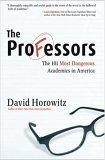
Ah, college…that idyllic period of youth spent acquiring knowledge and learning to think for oneself. This present-day myth meets reality in a new book by reformed leftist David Horowitz. It is no secret, of course, that most college professors espouse leftwing views, but their sheer radicalism, as documented on page after page, produces an intellectual reaction equivalent to vomiting a case of cheap wine. Consider Ward Churchill, who infamously declared that the victims of 9/11 were "little Eichmanns" Horowitz spends most of the book describing professors who have made a living defending Muslim terrorists and attacking the United States and Israel, but he also includes examples of extremist professors in almost every other area of political debate: reverse-racists, feminists, gay-rights lobbyists, and environmentalists. Most, such as Professor Vinay Lal of the University of California, confine themselves to making such absurd claims as: "Bush and bin Laden have a lot in common. If anything, bin Laden's parochialism is less offensive…. The fundamentalism of fanatical conviction knows no boundaries; rogues do understand each other." But some, such as Professor Bill Ayers of the University of Illinois, actually have a record of terrorist activity and have remained unrepentant about the damage they caused. Perhaps the most troubling part of Horowitz's thesis is that many professors hold few or no academic qualifications and use their position to indoctrinate their students and turn them into activists. Too many of the professors chronicled in this book seem to have forgotten that there is a difference between scholarship and activism. Not only do many professors wield absolute power in their own classrooms, they also control who else gets hired. Once a professor has gotten tenure, he may remain at the college for decades, where he can do great damage. Horowitz establishes his point with reams of evidence and effortlessly mows down any suspicion of exaggeration by quoting the professors themselves. Anyone can get something out of The ProFessors, but it is particularly suitable reading for the college-bound and their parents. (Regnery Publishing, Inc., 2006, $27.95) |
 and deserved their fate. Although he was subsequently removed from his position as department chair, he remains a professor at the University of Colorado and is widely sought after to speak at other colleges. Churchill's colleagues have for the most part reacted by giving him their unequivocal support. Although Churchill is one of the more extreme cases presented in The ProFessors, he cannot be dismissed as a fringe radical of academia because that entire world has fallen prey to similar wolves in sheeps' clothing.

