|
|
|
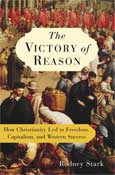
In a breathtaking new book, noted religious historian Rodney Stark propounds the startling thesis that Catholicism and Christianity and related institutions were directly responsible for the most significant intellectual, scientific, political, and economic breakthroughs of the last millennium. The standard narrative begins with the fall of the Roman Empire, continues through hundreds of years of Dark Ages stagnation, and then has civilization emerging with the Renaissance. Stark turns all this on its head.
Many authors have posited that capitalism is what drove the West's progress. But what made capitalism possible? The author makes a compelling case that it was Catholic theology that provided the framework and template for the great superstructure of Western science. And it is science, above all else, that has led to the supremacy of the West. The great works of rational theology by St. Thomas Aquinas, St. Augustine and the Scholastics were in marked contrast to the religious thinking of other cultures. The Greeks and Romans filled their heavens with a claque of quarreling gods, hardly the sort of worldview to encourage a systematic study of nature's secrets. Islam conceived of God as a free actor, and any attempt to divine His ways was considered blasphemy. The Chinese had a mystical view of God as an amorphous presence, so they sought enlightenment, not explanations. Historians often point to China and the Greeks as the great innovators, but the Chinese turned inward, safe behind their great defenses, and stagnated for centuries; their religion did not celebrate innovation and discovery. And while the Greeks were famously able in logic and mathematics, they were not oriented toward experiment and observation. It was the outward, heavenly focus of Christianity, as well as its focus on the importance of the individual, that propelled the West forward. Stark uses the current wave of globalization to buttress his argument. His quote from a prominent Chinese thinker is telling: "…the heart of your culture is… Christianity. That is why the West is so powerful. The Christian moral foundation was what made possible the emergence of capitalism and then the successful transition to democratic politics. We don't have any doubt about this." Maybe it's time we stopped doubting ourselves. The reader does not have to agree with all Stark's conclusions to learn much from this exuberant work. This book will alter your view of history. (Random House, 2006, 235 pp., $25.95) |
 In fact, the "Dark" Ages were a time of great technological advance. Industrious Dutch engineers built thousands of windmills to reclaim land from the sea - so many, in fact, that lawsuits alleging theft of one's wind were common! Other innovations included the effective shoeing and harnessing of horses for agriculture (something the Romans never accomplished), fish farming in man-made ponds on a continental scale, and the invention of eyeglasses and accurate timepieces. Familiarity with the Dialogues of Plato was not necessary for these breakthroughs.

