|
|
|
Paul Johnson may be the most fascinatingly idiosyncratic historian today. Any book he writes overflows with brilliant insights and bizarre opinions. Even if one doesn’t agree with everything he says (and surely very few do), he inspires reflection on important subjects and admiration for the depth of his thought. His newest book, Heroes, is no exception. The book begins with a treatment of biblical heroes: Samson, David, Deborah, and Judith. This chapter establishes the tone of the work. Johnson doesn’t shy away from criticizing his heroes or questioning the ethics of a particular action, but he draws a lesson from examining these figures: "What the stories…convey…is the element of physical ruthlessness involved in many acts of heroism….For these acts of violence are not, and never can be, routine….Heroism is usually loveless….The hero…must be capable of atrocity." This chapter also illustrates Johnson’s attempt to balance the sexes. Of thirty heroes, thirteen are women; this parity works as both an asset and a flaw of the book. Johnson rightly believes that heroism can be found in every walk of life and that in the past too much emphasis was placed on martial valor. In fact, he ends his description of Alexander the Great with these telling words: "[Alexander] was a murderer, and in his battles a mass murderer, a lifelong criminal whose crime was the supreme one of war." Hence the author's digressions into "the heroism of the hostess," "heroism behind the greasepaint," and so forth. However admirable the attempt to extend heroism to many occupations, one wishes that Johnson had found more suitable subjects than Mae West and Marilyn Monroe. Johnson’s reflections on more traditional heroes like George Washington, St. Thomas More, and Henry V, and even his treatment of unlikely heroes such as Ludwig Wittgenstein and Emily Dickinson, resonate with wit and perception. In the end, he recognizes four principal qualities that make up heroism: independence of mind, resolute and consistent action, the ability to ignore the media, and personal courage. "All history teaches, and certainly all my personal experience confirms, that there is no substitute for courage. It is the noblest and best of all qualities, and the one indispensable element in heroism in all its different manifestations." (Harper Collins, 2007, 320 pp, $25.95) |
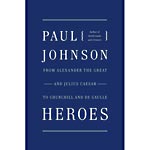 Johnson takes us on a grand tour through history, examining the strengths, flaws, and achievements of heroic men and women, working always toward understanding the essence of heroism. While one might quibble about some of his choices, Johnson has come through with a wise and delightful book.

