|
|
|
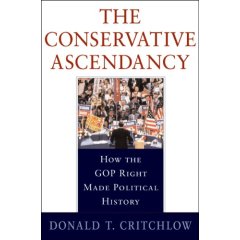
This major work by a distinguished historian traces the growth of the conservative movement since World War II, becoming the dominant political force by the end of the 20th century. Author Donald Critchlow's sympathetic treatment of the GOP Right is a refreshing departure from the typical academic spin placed on history. A professor of history at St. Louis University, Critchlow describes how a small unorganized band of writers and an equally unorganized collection of grassroots activists launched a counteroffensive against the prevailing economic and political order of the 1930s and 1940s, and grew into a powerful force in American politics. Long after Franklin D. Roosevelt was gone, conventional wisdom still considered his New Deal liberalism to be the wave of the future, Friedrich Hayek's The Road to Serfdom and Henry Hazlitt's Economics in One Lesson started the conservative movement on the road to demanding limited government, but the Communist external and internal threat was the issue that motivated the grassroots into direct political action. Small study groups were formed to educate U.S. citizens, who then were prepared to rally for Barry Goldwater's campaign in 1964. Those who lived through the political battles involving Robert Taft, Barry Goldwater, Richard Nixon, and Gerald Ford will enjoy the many details uncovered by Professor Critchlow in his extensive research, and even some of his 500+ footnotes make interesting reading. Younger readers will acquire a knowledge of history they won't learn in college. Critchlow shows how Ronald Reagan's victories were based on a coalition of three groups: the fiscal conservatives who had kept the faith despite Goldwater's massive defeat by Lyndon Johnson in 1964, the geographically dispersed anti-Communist groups, and the social conservatives who came into the political process in the campaigns against the Equal Rights Amendment and Roe v. Wade. Professor Critchlow's important book should be essential reading in college courses in history and political science. He so far seems to be the only historian who recognizes that the conservative ascendancy depended more on grasssroots activism than on the writers and so-called intellectuals. Conservative Ascendancy has been widely praised by other historians who recognize it as a judicious, discerning, and richly informative work. (Harvard University Press, 2007, 287 pp, $27.95) |
 while conservatives were believed to be an ineffective remnant waging a holding action against the inevitable socialism.

