|
|
|
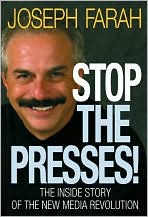
In a feisty new book, internet news pioneer Joseph Farah tells the story of what it was like at the moment of creation of the New Media. Along with Matt Drudge and Rush Limbaugh, Joseph Farah was in the advance guard of new journalists who took on the old media monopolies in the 'nineties. Farah details the building of the world's most popular source for news, World Net Daily, from humble beginnings in a home office when he and his wife were the only employees, to its current position as a global news powerhouse. He has all the anecdotes, and he reels them off with relish. Of course, coming of age as a fighter of governmental fraud, waste and abuse was hazardous since it happened during the Clinton years. Shortly after World Net Daily did a critical piece on the Clinton presidency in 1996, the IRS showed up to audit the company - and the agent actually told Farah that it was because he had taken on the President! This was the start of a long battle during which Farah was able to show that the harassment of his company was part of a wider pattern that included many conservative organizations hated by the Clinton machine. Farah makes a credible case, supported by testimony from several Tennessee newspapers, that World Net Daily's aggressive coverage of Al Gore's interference in criminal matters concerning relatives and associates cost Gore his own state in the 2000 election - and hence the presidency. Google is a favorite Farah target. He details the incredibly lopsided nature of Google's political donations, and tweaks that behemoth when he reveals the company's anger at his publishing the address and phone number of its CEO - which he found with a Google search. He just can't cozy up to a company that celebrates pagan holidays on its website, but not Memorial Day. Farah is a pugnacious optimist who has seen enough combat to know that constant vigilance will be required to keep the government's hands off the internet. Democrats are already making noises about "regulating" the New Media to keep it in line with their world view. But Joe Farah and his allies will not go quietly. They aim to keep the revolution rolling. No reader of ths book will doubt their ability to do so. (World Net Daily Books, 2007, 273 pp, $25.95) |
 Predictably, the grizzled defenders of press freedom were none too happy to see these upstarts infringing on their turf. The new wave were derided as mere "aggregators," as opposed to being "real journalists." But scandals like Dan Rather's hit piece on George W. Bush's national guard service, and plagiarism at the Washington Post and New York Times soon made a joke of that argument.

