|
|
|
Barry Goldwater’s doomed 1964 presidential run was the starting point for the conservative revolution that culminated in Ronald Reagan’s landslide victory in 1980. J. William Middendorf, the treasurer for the Goldwater campaign and a central figure in the Draft Goldwater movement, Unlike the typical presidential candidate, Barry Goldwater was a reluctant participant. It took a lot of cajoling to get him into the fight, and once in it, he turned out to be a hard fellow to manage. Always outspoken, and determined not to change his message or his personality, he was the very opposite of today’s prepackaged, media-attuned candidates. Goldwater was not a back-slapper or a baby kisser. He could growl at a reporter to "get that damn microphone out of here" and walk right by screaming fans to get in his car. But his sincere and deeply held belief in limited government, combined with his no-nonsense manner, inspired a generation of conservative activists. The campaign got off to a near-disastrous start in the New Hampshire primary, where Goldwater’s speeches were unfocused and scattershot. He refused to talk about local issues and lost to Henry Cabot Lodge (barely beating out Nelson Rockefeller). After this initial stumble, the campaign regrouped and won a string of primary victories. Goldwater loved to shoot from the hip (and often ended up hitting himself in the foot). This tendency, combined with the mainstream media’s total opposition to him, sowed the seeds for his defeat. Two issues dogged him throughout the campaign: Social Security and nuclear weapons. The Social Security issue was a pre-play of Democratic strategy for the next 40 years: scare seniors into believing Republicans wanted to cut off the money and let them starve. It proved effective in 1964 and still works today. Goldwater also made a relatively innocuous statement that NATO theater commanders should have the right to use small-scale tactical nuclear weapons (with higher-echelon approval). While this was actually U.S. policy at the time, the media transformed it into a nightmare scenario of trigger-happy sergeants launching missiles. He never recovered from the caricature. In the general election, Goldwater had to contend not only with the memory of John F. Kennedy, but also with the reality of Lyndon Johnson. Johnson was a master of dirty tricks, and employed what might be described as "Nixonian" tactics, right down to the use of CIA operative (and future Watergate star) Howard Hunt to help steal inside campaign information. Without Goldwater's philosophy to pave the way — and without the strategic and political infrastructure created by the Draft Goldwater movement — 20th-century politics would have been very different. (Basic Books, 2006, 273 pp, $26.95) |
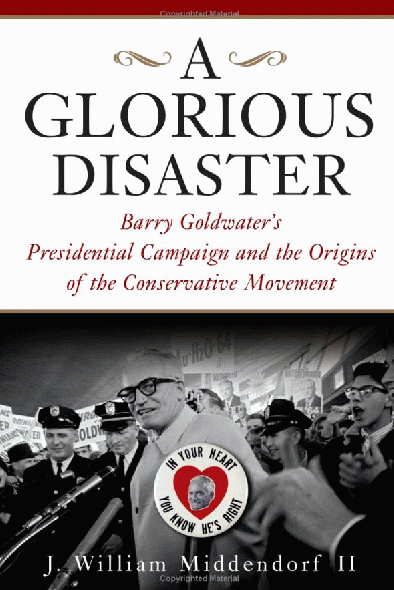 gives us a blow-by-blow account from a ringside seat.

