|
|
|
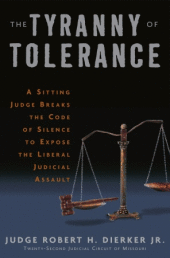
A St. Louis judge shares his outrage with judicial activism in this call to arms. Judge Dierker criticizes "femifascists," liberal "tyrants," homosexual "perversion," and "Blackmunized" judges. His book has prompted a feminist complaint of bias to the state judicial disciplinary body, but it seems destined to go nowhere given the author’s stellar ratings as a judge. The late Missouri supreme court chief justice Charles B. Blackmar observed in a review of Dierker’s book, Court-imposed reverse discrimination, abortion, pornographers’ rights, gay marriage, and prohibition of God in public places all fall under Judge Dierker’s lash. He pillories judicial hostility to punishment of criminals and terrorists, private property, gun rights, and free speech about favored classes. The "evolving Constitution," class-action tort lawsuits against tobacco companies and gun manufacturers, judicial restraints on school discipline, and the leftist takeover of the American Bar Association all come in for a measure of scorn. Case citations and other endnotes document his examples. The Tyranny of Tolerance is unique because of the author’s personal experience as attorney for the city of St. Louis and subsequently as judge in many high-profile cases emblematic of the judicial culture wars. As a lawyer, he encountered shameless quota requirements for promotion of firefighters, foisted on the city by the U.S. Justice Department and federal appellate judges. Representing the city in the St. Louis school desegregation case, he "became an eyewitness to the liberals’ manipulation of the federal judiciary to undo the Constitution" by raising property taxes, requiring nearly a billion dollars of state spending over fifteen years, and forcing suburban school districts to accept quotas of black students from the city. As a judge, Dierker observed scandalous appellate court interference in death-penalty cases and federal court interference in prison administration. This Harvard-trained lawyer devotes considerable attention to the recent series of federal cases involving the rights of captured terrorists, concluding that the Supreme Court is engaged in intolerable second-guessing of the commander-in-chief and Congress. What is to be done? Dierker recommends public pressure for appointment of "committed republican jurists"; a change of Senate rules to stop filibusters of nominations of federal judges; Congressional action to limit injunctions, habeas corpus and affirmative action; and the refusal by the executive or legislative branch to enforce court orders intruding on those branches’ powers of warmaking and taxation. (Crown Publishing Group, 2006, 233 pp, $26.95) |
 "I am confident that the Supreme Court of Missouri would never discipline a judge for exercising his right of freedom of expression, as guaranteed by the Constitution."

