|
|
|
The ancient Greek Pythagoras thought that the Earth revolved around the Sun, and that the world could be explained by mathematics. Aristotle correctly figured out that the Earth was round, but argued that we would feel the motion if it were moving. Two millennia later, Tycho and Kepler created the best astronomical models anyone ever did without a telescope, but they did not agree about whether the Earth moved. Galileo ignored that, and argued fallaciously that the Earth's motion caused one ocean tide per day.
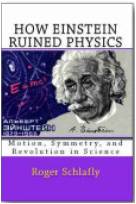
The theory said that motion is relative to the observer, and so is space and time. It was a new mechanic in which nothing goes faster than the speed of light. Roger Schlafly's book, How Einstein Ruined Physics, tells this story. It details the history of relativity, and how the theory made Albert Einstein famous. Einstein is now considered the greatest genius who ever lived, and is quoted as an intellectual authority on many topics. Schlafly exposes many myths. He breaks relativity down to about ten crucial ideas, and shows with quotes that Einstein was behind the curve on all of them. The most exciting idea was the formulation of relativity as a four-dimensional geometry, but Einstein did not discover that and did not even understand what had been published on the subject years earlier. Historians and philosophers not only perpetuate the myth that Einstein created relativity; they also claim that he did so by applying pure thought about how the world ought to be, without paying any attention to that 1887 experiment. This was something that they now call a "scientific revolution," or a "paradigm shift." That is where some new young "Einstein" declares that the authorities are wrong, but he cannot prove it. Supposedly his ideas only catch on because they happen to be appealing to other such enlightened younger scientists -- like some sort of irrational fad that has nothing to do with common-sense notions of science. Schlafly convincingly demolishes the portrayal of the history of science in terms of paradigm shifts and revolutions. He goes against a great many scholars who argue that paradigm shifts show that science is not really as rational as it pretends to be, and against physicists who promote fanciful theories about extra dimensions, multiple universes, and other ghostly inventions. They all say that they are following Einstein's example. This book shows how foolish the example is. (CreateSpace, 2011, 350 pp., $20) |
 In 1887, scientists were baffled by an optical experiment that failed to detect the Earth's motion. Hendrik Lorentz and Henri Poincaré discovered the theory of relativity to explain this experiment.

