|
|
|
If you are a student trying to decide where to go to college, or if you are a college student’s parents wondering if it is worth taking out a second mortgage or invading your retirement fund to send your child to college, the next two books are for you. They provide a mountain of information — some of it very needed, some of it very depressing — for anyone about to make those decisions.
The average student graduates with $23,000 in student-loan debt and $3,000 in credit-card debt. Zac explains how students and parents can evaluate scholarship and financial aid packages. He tells students they should absolutely not take out any student loans and parents should not jeopardize their own financial security to help pay for college. One tip is, don’t rely on high school and college counselors for advice. They are not reliable sources of information; they work for the school or college and have the institution’s financial interest at heart, not the student’s. Zac has the answer to the argument that college debt is a good form of debt because it will help kids earn more money. (Portfolio/Penguin, 2010, 304 pp., $16.00). |
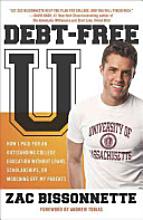 Zac Bissonnette was a senior at the University of Massachusetts when he wrote this book to guide other students through the high-class con game of getting a higher education. He shares everything students need to know about college funding, financial management, earning money during college, selecting a major, and using credit.
|
|
|
Craig Brandon’s book is very depressing. He describes both the waste of money that students and their parents spend (or borrow) to pay for what they think is the gateway to a good job and a prosperous life, and the waste of young Americans’ prime years of energy and creativity. He says that as many as 400 universities are subprime schools which have effectively given up on education and can be accurately called party schools. The title of this book reminds us that the majority of college students take five years, not four, to graduate. That doesn’t even count the 40% of students who enroll as freshmen but leave without getting a degree. Colleges are interested in making money and acquiring as much government funding as possible, so they want to attract as many students as possible. Classes are adjusted so they are not too demanding on students. Colleges often cover up crime statistics and don’t notify parents about crimes or accidents their children are involved in. Many campuses are breeding grounds for binge drinking and drug use, and almost 1,700 college students a year die while drunk. Colleges have an obsession with secrecy and misuse the federal law called FERPA to conceal vital information from parents, even about their own children. Brandon concludes with helpful suggestions on how parents can identify and avoid colleges that are party schools and help to return them to true educational institutions. (BenBella Books, 2010, 234 pp., $14.95) |

