|
|
|
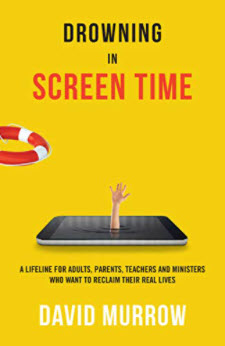
The coronavirus crisis was just beginning when David Murrow finished writing his book, and the timing for its release could not have been better. For with the COVID-19 pandemic, which Murrow calls "the rogue wave that no one saw coming," people of all ages became more dependent than ever on their use of electronic devices. And while these technologies are truly amazing and can provide tremendous benefits, they also pose grave dangers, particularly for children and teens. Murrow writes that "even before the virus lockdowns confined us to our homes, humanity was drowning in screen time. A pre-virus survey found that the typical American consumes nine hours of screen entertainment each day," and that "screens have been socially distancing us since they began entering our living rooms in the 1950s." Most people today take screen time for granted. It is so much a part of our lives that we don't really think about it. Our devices have become overused. Texting and email replace telephone conversations, and the result is that people become more isolated. Murrow writes that our youth, even though feeling the sting of isolation and loneliness, are uncomfortable with face-to-face interaction and often shun real relationships. The upside is that among our youngest generation, risky behaviors including drug use, petty crime, experimentation with sex and alcohol, and other forms of youthful rebellion have all decreased. The downside is that weight gain, sleeplessness, online bullying, depression and even suicide are all on the rise. Drowning in Screen Time's opening chapter illustrates the issues with screens through five "parables," each one with a lesson in how we become slaves to our devices. The remainder of the book builds on these parables with the overarching message that our devices fill time that might otherwise be used more beneficially, such as in reading, meditation, or first-person interaction with our families and the real world. Murrow reports that the greatest chunk of screen time is still spent watching TV, particularly among adults. As may be expected, teens and "tweens" spend more time on social media, typically on their smart phones, playing video games, texting and watching online videos. "By age twelve," he writes, "69 percent of American kids have their own smart phones." Attention to digital media is weakening relationships and causing estrangement even among family members living in the same house. Perhaps the most sobering chapters of the book cover two different but very troubling topics. The first is how users are manipulated by the algorithms embedded in search engines and social media platforms such as Facebook and Twitter. The author call them "the great dividers." Algorithms sort us into "markets" for advertising, but more dangerously, they split us into "ideological tribes" based on our preferred content. Enter the disinformation trolls who feed into people's fears and distrust of opposing beliefs and viewpoints. These trolls are often foreign agents who seek to create strife among Americans by sowing misleading and often false information, which exacerbates our differences and empowers distrust. The book cites a 2018 study which found: "In the era of social media and partisan news outlets, America's differences have become dangerously tribal, fueled by a culture of outrage and taking offense. For the combatants, the other side can no longer be tolerated, and no price is too high to defeat them." The second even more vexing topic is the explosion of online pornography and the sex trafficking social media enables. Pornography has become so readily available online that it practically assures addiction, destroying marriages and relationships in the process, and preventing youthful addicts from forming normal, lasting relationships later in life. Most addicts need professional help to overcome their addiction. Perhaps most egregious are the internet-related abductions of children by pedophile rings who sell photos and videos of abuse victims on the dark web. Murrow points out the tragic irony of how parents in today's society have become "fixated on children's physical safety, while a child with an internet-enabled device is far more likely to be victimized than one who governs herself in a public space. Predators no longer hide in the bushes. Instead, they prowl social media, cloaked in anonymity, stalking hundreds of potential victims at once." Despite the numerous pitfalls, Murrow admits that electronic media provide amazing benefits to human beings and are invaluable resources for information and communication. He recounts his interaction with loved ones in Australia while he and his wife were walking down their rural road in Alaska. "We were in different hemispheres, experiencing different seasons of the year, seeing and hearing each other in real time." He continues: "I am able to pull up a website and transfer wealth to the other side of the planet in a matter of minutes… Folks, this is a miracle." The challenge he poses is that we make proper use of this miracle by controlling our use of it rather than allowing its many dark sides to control us. Nearly every section of Drowning in Screen Time provides links to the author's website (www.DavidMurrow.com) where readers can find more information and resources. He ends with advice on how to overcome dependence on our devices, so that we can enjoy the benefits while avoiding addiction. Everyone who uses a computer or owns a smart phone, particularly families with children, should avail themselves of this enlightening book. Salem Books, 2020 |
 The author admits he himself was addicted to electronic devices starting with the black and white TV his father brought home when he was a young child in the early 1960s. His father became addicted to television viewing, and the author followed suit. When cable TV and the VCR entered the market, along with computers, the internet, and eventually smart phones and iPads, most Americans became hooked. By 2010, Murrow's wife and children confronted him about his screen addiction, and he had to face the truth: "I was trading away real life for screen life, just as my father had."
